There’s something special about music. Clearly it wouldn’t play such a major part in my life and the life of so many other people if it wasn’t somehow special. The hundred year old technology of recorded sound should still qualify as one of the great achievements of our time. Yet it has become so ubiquitous, so commonplace, that it devalues and banalises that which it was invented to preserve.
From the radios in our cars to the music piped into every lift, the omnipresence of recorded music obscures the greatness of that music. Who sits in their local coffee house and ponders how many years of craftsmanship, practice and hard work went into the trumpet solo on the Miles Davis record that’s playing? I’m pretty sure it’s just me. For that matter I’m pretty sure I’m in a minority even noticing which record is playing. There’s so much wonderful music out there, and yet by putting it everywhere we go, we forget its brilliance.
Indirectly this lack of value placed on music manifests in underpaid musicians and the fact that no one stops to listen to buskers.
All of which, by somewhat circuitous route, bring me to my love of vinyl. I’m no Luddite. Digital music has much to offer. Reduced recording and distribution costs associated with the digital format mean many wonderful artists are easily accessible who wouldn’t be otherwise, and as if to prove that point I own two packed mp3 players. But, in my life at least, digital music seems to inevitably form the background to some other activity, whether it’s listening to my mp3 player on my run, streaming internet radio as I type this, or even the CD that plays in the kitchen as I make dinner, it always seems secondary to the task in hand. We put on digital music, just to ignore it.
A good old fashioned record doesn’t do that. You can’t put a turntable in your car (not since the invention of the speed hump at any rate). You can’t spin a Long Player on your jog. Records are beautiful, bulky delicate things that need to be handled with love. So when you put on an LP you have to carefully drop the needle onto the crackly surface, sit down in your living room and actually listen to the warm sounds flowing forth. A little ritual to pay homage to the miracle of recorded sound, to the fact that this music is so good it couldn’t be left in the moment it was played, but instead needed to be preserved to be repeated and enjoyed again and again.
Friday, 15 April 2011
Sunday, 23 January 2011
My taste in guitars
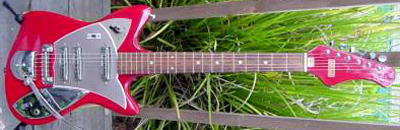
| Why do all guitars have to look like this... |
As a guitarist I think I’m fairly unusual in that I tend to find expensive guitars incomprehensibly unexciting. What excites me is the quirky, cheap and unusual. My dream is not of one day affording a 1962 Stratocaster in mint condition, but rather of unearthing something unique and bizarre sounding in a pawn shop.
Alas the way in which guitars are manufactured and designed in the modern age means that this is probably just as unlikely as that ’62 Strat falling into my lap. The revolution in Far eastern manufacturing means that, by and large, cheap guitars look and sound very much like the expensive ones. This is a mixed blessing in many ways. There’s no doubt that compared to picking up a bottom of the market guitar 30 years ago, the difference in playability is astounding. My father tells tales of guitars with two inches of string clearance that may as well have been strung with barbed wire. But in those days cheap electric guitars were built to whatever shape and design floated the manufacturer’s boat. These days they’re effectively built to two designs, The Stratocaster or the Les Paul, and to my mind the world is poorer for that.
...when they used to look like this?
I guess my love of resonators come from that desire for the ‘different’ in guitars. What could be more different than a guitar that sounds like a tin dustbin? My main gigging axe was £160 new on EBay. It’s made of cheap Chinese plywood and when you look at it closely the f-holes aren’t exactly the same size. It’s been glued back together with epoxy after the guitar strap came off and sent it crashing into a drum kit. It's missing a volume knob these days as well. I changed the main pickup myself after that developed a loose connection that caused it to only work intermittently, and I love the beast all the more for that, because it doesn’t look or sound like all the other guitars out there.
My trusty resonator, in a shot from the album cover shoot
Tuesday, 18 January 2011
Marketing strategies....

OK, so maybe I bought into the whole 'don't need a record label' idea a little bit too whole-heartedly. The net is full of articles about how easy it is to put out a CD yourself, and they're all true. It was very easy. However, I find myself with a spare bedroom full of albums and realise I'd only thought this one through so far. The whole process of making a record was great fun, and I was happily swept along by it all. Recording it ourselves without anyone looking over our shoulder, getting it professionally mastered, seeing and hearing the finished product is all a dream come true and I'm tremendously proud of what we've done. Yet it suddenly dawns on me this CD isn't going to sell itself.
For a signed artist this is where the label would swing into action and their massive advertising budget and finely honed PR team would make the whole world believe they need our record now. I've got a book called "DIY PR" out of the library and two days off from the day job a week to try and do the same! Meanwhile, the 5 CDs I sent to CD Baby in order for them to get the album onto Amazon and iTunes seem to be in the ether somewhere mid-Atlantic and I'm fidgeting nervously and putting 'available to download soon' on press releases. For all my confidence in what I do, I suppose this is the first time I've had money over and above the price of a tank of petrol invested in my own music career & I'm actually feeling a little out of my depth.
But hey why not download some free songs from soundcloud and if you like those, plod over to 44pistol.co.uk and order the album! /shameless plug :)
Friday, 22 October 2010
My journey to the blues, or how R.L. Burnside saved me from a lifetime of polite jazz appreciation...
The Conventional History of The Blues, as recorded by a British music scholar or American folklorist in the mid nineteen-sixties, states that blues music was born in the Mississippi Delta in the twenties and thirties where men like Robert Johnson played blues in Juke Joints or farm shacks, drank bad whisky and picked fights. As mechanisation made large numbers of agricultural workers obsolete The Blues moved north to Chicago, where men like Muddy Waters plugged in their guitars and invented the electric blues. Eric Clapton, Stevie Ray Vaughn and ZZ Top were only a step away.
This, it's probably unnecessary to say, is a bit of a simplification.
Which brings me to my own epiphany. Having loved blues from an early age, by about seventeen I'd grown tired of widdly guitar solos and the hunt for the next SRV. I'd got into the uber-sophisticated world of jazz, where music isn't loved on a gut level, but appreciated for it's cleverness. Miles Davis and Thelonious Monk, although clearly brilliant musicians, have never produced music you can dance to. I'd downloaded a song by this chap called R.L. Burnside, I'm not sure exactly where from, but it was in the glorious free-for-all of the first rush of Napster, so that would be a likely contender. Having quite enjoyed it I picked up an album, I think during my travels in Australia, and I was totally blown away.
What the usual version of blues-history skims over is the fact that the exodus north was by no means universal. Plenty of people stayed behind in Mississippi. Some, like Burnside himself, moved north but didn't like it and so went home to drive tractors. These people didn't give up their culture and traditions, but neither did they preserve them in stone. They bought electric guitars, and John Lee Hooker records and listened to the radio and learnt off their neighbours and went largely unnoticed by everyone in the outside world who were too busy listening to Stevie Ray and Buddy Guy as the people of North Mississippi created the trance-like dirty, wonderful blues music that I first discovered as I listened to that R.L. Burnside CD.
So Miles Davis was just a fad for me. In the next couple of years I'd resumed playing the harmonica, taken up guitar and started learning Son House slide licks. Almost ten years on and I've been working steadily as a musician for a little over three years, and I'm desperate to give up the day job. I've done my share of drifting, but I like to think that moment, when I first fell back into love with blues music was the first step on the road to where I am now.
Thursday, 7 October 2010
Review: C.W. Stoneking & the Primitive Horn Orchestra
I wrote this last month, after watching C.W. Stoneking's gig in Birmingham. I'd submitted it to a blues publication, but since it doesn't appear to have gone in, I thought I'd share it here. Hope this is of interest to some of you :-)
C.W. Stoneking & the Primitive Horn Orchestra, at the O2 academy, Birmingham 1/9/10
It’s Birmingham on a Wednesday evening and the yellow sun casts an autumnal glow over the locked up industrial units that line the Queensway dual carriageway. With the hum of traffic, and wafting smells of Indian takeaways and kebab houses this really couldn’t feel more like the English Midlands in the twenty-first century. An hour later. Searing horns, scratchy banjo and it’s New Orleans in nineteen ten. Mr C.W. Stoneking, renowned composer of blues, hokum and jungle music is in town.
To say that seeing this branch of music revived looked unlikely would be an understatement. An Australian in his mid-thirties Stoneking offers a broad pastiche of various pre-war second world war genres, drawing on the cartoonish hokum blues of the American deep south medicine shows and the Calypso of Trinidad along with the more widely known music of the Mississippi delta and New Orleans. Blending these influences with his own somewhat offbeat humour, and his semi-fictional back story he produces a music that’s very much his own and yet never sounds a day younger than the Marshall Plan. Touring with his backing band The Primitive Horn Orchestra to promote the official European release of his second album ‘Jungle Blues’ (although those of us in the know have had the Australian import for months) he’s drawn around forty people to the tiny 3rd venue at the O2 academy. There’s no support act, so at around five minutes past nine the man himself takes to the stage. Dressed strikingly in white linen, with a red bowtie and brylcreem hair, CW himself looks very much the part, while the Primitive Horns in jeans and crumpled shirts, look much more like the kind of musicians one imagines more often grace this stage.
The front-man swaps between a steel resonator guitar and an open backed four-string banjo, and sings in a graceful, gravely mumble that sounds forced, until you hear his identical speaking voice. He plays for a little over an hour, interspersing band numbers with solo material. Well thought out arrangements make excellent use of the band, with the trombone (played by Kynan Robinson)
and cornet (Stephen Grant) playing in unison, or weaving in and out of each other as appropriate. The rhythm section comprises a tuba (James Clark), sometimes swapped for a double bass and a mismatched battered looking drum kit, which looks as if it has been rescued from a variety of skips over a number of years and is expertly worked by Ollie Brown, mostly with felt mallets rather than sticks and sounding more like orchestral percussion than the simple timekeeping device of the modern rock band. With a touch of theatre clearly borrowed from the medicine show, songs begin with faked crowd noise, conversations recounted by C.W. in barely-differing voices, or even a ship’s fog-horn.
The evening ambles along at a gentle mid-paced tempo. Although most of the carefully crafted material has an upbeat, cheery edge to it, there’s no easy-to-dance-to barnstormers thrown in. You almost feel they wouldn’t be authentic enough.
The highlight of the evening is the dark & atmospheric, ‘Don’t Go Dancing Down the Darktown Strutter’s Ball’ which is introduced with a rambling humorous anecdote about Stoneking’s time living in New Orleans, working as an assistant to a Hoodoo witchdoctor (strangely omitted from his official biography, almost as if he was making it up). He starts the tune alone accompanying himself with a delicate banjo line, and around the second chorus the band emerge on stage and fill the sound with some beautiful haunting brass lines.
An encore of a Big Bill Broonzy number sees the band pick up the pace and then C.W. is out in the crowd, signing records and shaking hands next to the digital mixing desk and blue neon bar, like some Mississippi paddleboat band-leader thrown forward in time a hundred years and suddenly seeming totally out of place. To see a new act taking inspiration from such unusual and largely forgotten branches of music was a surprise, but to see it executed so well is remarkable.
Pete Wearn
Thursday, 23 September 2010
.44 Pistol album in the pipeline.
Some of you will have spotted this from my comments on twitter and facebook, but you can consider this the official announcement that .44 Pistol are working on what we hope will eventually be our first self-released album. In a fit either of ambitious
control freakiness, or tight-fisted reluctance to spend money, we decided to have a bash at doing it all ourselves. This was at least in part down to all the studios we spoke to being somewhat reluctant to track the whole band 'live' in the room instead of one by one to a click track, a technique which seemed almost certain to suck all the soul out of our ragged and dirty approach to music.
So there's been something of a steep learning curve for me as engineer. Session #1 took place in my dining room/study. Thanks must go to my surprisingly understanding neighbours, who didn't bang the wall once! We managed to lay down six songs in a couple of hours, and generally we're pretty pleased with how it's all sounding...except with my inexperience showing through we've ended up with what might just be the worst sounding kick drum ever recorded. I'm still trying to mix my way around the damn thing and praying that most people only listen to it in the car or on their iPod where it doesn't show up in the same way as on the good hi-fi in the living room!
Session #2 was at our usual rehearsal space, the function room of The Prince of Wales. The good news is that, after a good spell of reading up on what I'd done wrong, the kick drum is sounding greatly improved. Unfortunately whether it was down to not being able to hear myself over Dunc's tub-thumping, or my bi-annual bout of asthma, most of the vocals are as ropey as hell. So the question is, do I overdub the vocals and abandon the pretence that it's a 'live in the studio' effort, or get the whole gang together again and re-do the whole session? I'm edging toward the overdub option at the minute, but it does feel rather like cheating. Perhaps I should just attack them with the auto-tune and make the whole thing sound like an X-factor winner ;-)
Still once I've done some research on getting the thing mastered and pressed, we should be able to at least let you know a likely release date pretty soon. Hoping to hit the shelves in time for that xmas rush!
Alas time to get back to mixing!
Pete
Sunday, 4 April 2010
More musical fun!

We had an awesome time at Nantwich jazz and blues festival yesterday. Thanks to everyone who came to talk to us afterwards, sorry if we were all a bit spaced! Thanks especially to the Blind Summit Blues Band for bailing me out after I forgot all my harmonicas. I thoroughly enjoyed watching lap slide player Tom Doughty & Rockabilly band Vavoom whilst there as well.
I've decided to use my Easter Sunday off to try and tidy up our web prescence. I spent this morning trying to sort out the myspace page and this afternoon trying to remember HTML I last used when I was 17 in order to get a website site up. I also suddenly realised I hadn't updated this blog in 4 months.
In other news we're through to the final of the Staffordshire University Battle of the bands (final april 20th - be there or be...somewhere else), which is good. Plus there's a crazy schedule of gigs coming up in the next couple of months. Looking forward to my holiday already!
Subscribe to:
Posts (Atom)