"Never begrudge another musician a living"
Advice my father gave me when, as a teenager, I took exception to a lounge pianist transforming Stairway to heaven into gentle background music and probably complained a little too loud. It's very much something I've found I live by since I've become more serious as a musician myself. I try not to be too dismissive of things that simply aren't to my taste. I'd never really want to find myself in a drum and bass act, but if other folks enjoy it and can make a living who am I to judge?
Although most of the musicians I know have much broader listening tastes than what you might call a general punter, I do still sometimes hear crude generalisations and dismissals that make my stomach turn. When someone tells me they 'hate jazz' or they 'can't stand country music', I often want to take them to one side and ask how the hell they know without having listened to all of it. For a start most genres are extremely broad churches. 'Jazz' for instance encompasses everything from Herbie Hancock's funk era, to Kenny G. You are of course free to dislike one or both artists, but Mr Hancock's edgy experimentalism, and Mr Gorelick's smooth, processed MOR saxophone are more different than they are similar. Likewise with C&W, you've got everything from scratchy prewar recordings of the Carter Family, to Shania Twain or Taylor Swift. The differences between live takes of a family band reviving traditional songs and modern processed studio-pop where the 'artist' seems to be something of an afterthought are far more profound than the similarities, even if they ostensibly belong to the same genre.
Which brings me to the one thing I really can't stand in music, which is blandness. From the ultra-traditional to the far-out and experimental, even if something isn't to my taste, I can usually admire the musicianship, and recognise the passion being put in. Much mainstream pop of the X-factor variety leaves me cold, because it is so artificial and unexciting. It very often sounds like no-one involved really gave a toss about any kid of self-expression and were just thinking of the paycheck. Not that people can't do a good job in those kind of circumstances, but it seems like they don't make for great records, however well they sell until their limited shelf life runs out. Slick production can never make up for the fact there's no real feeling behind the notes in the first place, and that's perhaps why, while these records may sell, they do't seem to last.
But then I've sat on the opposite side of the fence and often argued in the past that .44 pistol should push the good-time-party-band aspect more, at the expense of naval-gazing songwriting, or endless slow blues that are immensely satisfying to play, but in my own experience as a gig goer, somewhat uninspiring to watch, particularly if you're hitting the pub for a good time on a Friday night. Unfortunately if you follow the line of thinking that you should please the crowd rather than yourself to it's logical conclusion then you'll wake up one day in an Abba tribute band*, rehashing the very bland pop music that I was ranting against in the last paragraph. Just because it's popular, doesn't make it good. Which I suppose means I fall somewhere in the middle, I feel i should please the crowd, but I don't think that has to preclude educating them a little as to what a broad church good music really is.
*Somewhat bizarrely my Dad was recently asked to join an Abba tribute band. I´ve never worked out whether he was going to be Benny or Bjorn
Wednesday, 22 February 2012

Wednesday, 12 October 2011
Mid-life Crisis?
I turned 30 last week.
Now I understand it's traditional to have some kind of mid-life crisis at this point, and purchase a motorcycle or take up base jumping. Instead I found myself being presented at my birthday party with a trombone I don't have the faintest clue how to play. This came slightly less out of the blue than it might first appear and was clearly a sign that my good lady wife had been paying rather more attention to the things I say than I had. Those who follow my twitter & facebook feeds will already know that I've developed something of an obsession with New Orleans Brass Bands since watching David 'The Wire' Simon's New Orleans set TV series 'Treme' on DVD a few months back. Cruising down the motorway with the Rebirth Brass Band cranked up good and loud, I had expressed a desire to own a trombone and then promptly forgotten about it. That was until Mrs Wearn presented me with one.
So now I'm making my first fart-sounding notes from the instrument I'm wondering if this is my own special music-geek version of a mid-life crisis? Given I still can't play harmonica like James Cotton, or slide guitar like Son House after years of trying, am I just being distracted by something new and exciting? Should I have just traded in the tour bus for a zippy red convertible and been done with it? Alternatively I might be joining the Memphis horns in 6 months, you never know...
Still just to prove that in spite of it's image the trombone is every bit as cool as a guitar or drum kit, here's a little clip of Rebirth funkin' it up:
Now I understand it's traditional to have some kind of mid-life crisis at this point, and purchase a motorcycle or take up base jumping. Instead I found myself being presented at my birthday party with a trombone I don't have the faintest clue how to play. This came slightly less out of the blue than it might first appear and was clearly a sign that my good lady wife had been paying rather more attention to the things I say than I had. Those who follow my twitter & facebook feeds will already know that I've developed something of an obsession with New Orleans Brass Bands since watching David 'The Wire' Simon's New Orleans set TV series 'Treme' on DVD a few months back. Cruising down the motorway with the Rebirth Brass Band cranked up good and loud, I had expressed a desire to own a trombone and then promptly forgotten about it. That was until Mrs Wearn presented me with one.
So now I'm making my first fart-sounding notes from the instrument I'm wondering if this is my own special music-geek version of a mid-life crisis? Given I still can't play harmonica like James Cotton, or slide guitar like Son House after years of trying, am I just being distracted by something new and exciting? Should I have just traded in the tour bus for a zippy red convertible and been done with it? Alternatively I might be joining the Memphis horns in 6 months, you never know...
Still just to prove that in spite of it's image the trombone is every bit as cool as a guitar or drum kit, here's a little clip of Rebirth funkin' it up:
Friday, 15 April 2011
The joy of a good record...
There’s something special about music. Clearly it wouldn’t play such a major part in my life and the life of so many other people if it wasn’t somehow special. The hundred year old technology of recorded sound should still qualify as one of the great achievements of our time. Yet it has become so ubiquitous, so commonplace, that it devalues and banalises that which it was invented to preserve.
From the radios in our cars to the music piped into every lift, the omnipresence of recorded music obscures the greatness of that music. Who sits in their local coffee house and ponders how many years of craftsmanship, practice and hard work went into the trumpet solo on the Miles Davis record that’s playing? I’m pretty sure it’s just me. For that matter I’m pretty sure I’m in a minority even noticing which record is playing. There’s so much wonderful music out there, and yet by putting it everywhere we go, we forget its brilliance.

Indirectly this lack of value placed on music manifests in underpaid musicians and the fact that no one stops to listen to buskers.
All of which, by somewhat circuitous route, bring me to my love of vinyl. I’m no Luddite. Digital music has much to offer. Reduced recording and distribution costs associated with the digital format mean many wonderful artists are easily accessible who wouldn’t be otherwise, and as if to prove that point I own two packed mp3 players. But, in my life at least, digital music seems to inevitably form the background to some other activity, whether it’s listening to my mp3 player on my run, streaming internet radio as I type this, or even the CD that plays in the kitchen as I make dinner, it always seems secondary to the task in hand. We put on digital music, just to ignore it.
A good old fashioned record doesn’t do that. You can’t put a turntable in your car (not since the invention of the speed hump at any rate). You can’t spin a Long Player on your jog. Records are beautiful, bulky delicate things that need to be handled with love. So when you put on an LP you have to carefully drop the needle onto the crackly surface, sit down in your living room and actually listen to the warm sounds flowing forth. A little ritual to pay homage to the miracle of recorded sound, to the fact that this music is so good it couldn’t be left in the moment it was played, but instead needed to be preserved to be repeated and enjoyed again and again.
From the radios in our cars to the music piped into every lift, the omnipresence of recorded music obscures the greatness of that music. Who sits in their local coffee house and ponders how many years of craftsmanship, practice and hard work went into the trumpet solo on the Miles Davis record that’s playing? I’m pretty sure it’s just me. For that matter I’m pretty sure I’m in a minority even noticing which record is playing. There’s so much wonderful music out there, and yet by putting it everywhere we go, we forget its brilliance.

Indirectly this lack of value placed on music manifests in underpaid musicians and the fact that no one stops to listen to buskers.
All of which, by somewhat circuitous route, bring me to my love of vinyl. I’m no Luddite. Digital music has much to offer. Reduced recording and distribution costs associated with the digital format mean many wonderful artists are easily accessible who wouldn’t be otherwise, and as if to prove that point I own two packed mp3 players. But, in my life at least, digital music seems to inevitably form the background to some other activity, whether it’s listening to my mp3 player on my run, streaming internet radio as I type this, or even the CD that plays in the kitchen as I make dinner, it always seems secondary to the task in hand. We put on digital music, just to ignore it.
A good old fashioned record doesn’t do that. You can’t put a turntable in your car (not since the invention of the speed hump at any rate). You can’t spin a Long Player on your jog. Records are beautiful, bulky delicate things that need to be handled with love. So when you put on an LP you have to carefully drop the needle onto the crackly surface, sit down in your living room and actually listen to the warm sounds flowing forth. A little ritual to pay homage to the miracle of recorded sound, to the fact that this music is so good it couldn’t be left in the moment it was played, but instead needed to be preserved to be repeated and enjoyed again and again.
Sunday, 23 January 2011
My taste in guitars
| Why do all guitars have to look like this... |

As a guitarist I think I’m fairly unusual in that I tend to find expensive guitars incomprehensibly unexciting. What excites me is the quirky, cheap and unusual. My dream is not of one day affording a 1962 Stratocaster in mint condition, but rather of unearthing something unique and bizarre sounding in a pawn shop.
Alas the way in which guitars are manufactured and designed in the modern age means that this is probably just as unlikely as that ’62 Strat falling into my lap. The revolution in Far eastern manufacturing means that, by and large, cheap guitars look and sound very much like the expensive ones. This is a mixed blessing in many ways. There’s no doubt that compared to picking up a bottom of the market guitar 30 years ago, the difference in playability is astounding. My father tells tales of guitars with two inches of string clearance that may as well have been strung with barbed wire. But in those days cheap electric guitars were built to whatever shape and design floated the manufacturer’s boat. These days they’re effectively built to two designs, The Stratocaster or the Les Paul, and to my mind the world is poorer for that.
...when they used to look like this?
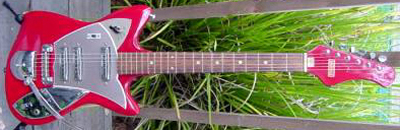
I guess my love of resonators come from that desire for the ‘different’ in guitars. What could be more different than a guitar that sounds like a tin dustbin? My main gigging axe was £160 new on EBay. It’s made of cheap Chinese plywood and when you look at it closely the f-holes aren’t exactly the same size. It’s been glued back together with epoxy after the guitar strap came off and sent it crashing into a drum kit. It's missing a volume knob these days as well. I changed the main pickup myself after that developed a loose connection that caused it to only work intermittently, and I love the beast all the more for that, because it doesn’t look or sound like all the other guitars out there.

My trusty resonator, in a shot from the album cover shoot
Tuesday, 18 January 2011
Marketing strategies....

OK, so maybe I bought into the whole 'don't need a record label' idea a little bit too whole-heartedly. The net is full of articles about how easy it is to put out a CD yourself, and they're all true. It was very easy. However, I find myself with a spare bedroom full of albums and realise I'd only thought this one through so far. The whole process of making a record was great fun, and I was happily swept along by it all. Recording it ourselves without anyone looking over our shoulder, getting it professionally mastered, seeing and hearing the finished product is all a dream come true and I'm tremendously proud of what we've done. Yet it suddenly dawns on me this CD isn't going to sell itself.
For a signed artist this is where the label would swing into action and their massive advertising budget and finely honed PR team would make the whole world believe they need our record now. I've got a book called "DIY PR" out of the library and two days off from the day job a week to try and do the same! Meanwhile, the 5 CDs I sent to CD Baby in order for them to get the album onto Amazon and iTunes seem to be in the ether somewhere mid-Atlantic and I'm fidgeting nervously and putting 'available to download soon' on press releases. For all my confidence in what I do, I suppose this is the first time I've had money over and above the price of a tank of petrol invested in my own music career & I'm actually feeling a little out of my depth.
But hey why not download some free songs from soundcloud and if you like those, plod over to 44pistol.co.uk and order the album! /shameless plug :)
Friday, 22 October 2010
My journey to the blues, or how R.L. Burnside saved me from a lifetime of polite jazz appreciation...

The Conventional History of The Blues, as recorded by a British music scholar or American folklorist in the mid nineteen-sixties, states that blues music was born in the Mississippi Delta in the twenties and thirties where men like Robert Johnson played blues in Juke Joints or farm shacks, drank bad whisky and picked fights. As mechanisation made large numbers of agricultural workers obsolete The Blues moved north to Chicago, where men like Muddy Waters plugged in their guitars and invented the electric blues. Eric Clapton, Stevie Ray Vaughn and ZZ Top were only a step away.
This, it's probably unnecessary to say, is a bit of a simplification.
Which brings me to my own epiphany. Having loved blues from an early age, by about seventeen I'd grown tired of widdly guitar solos and the hunt for the next SRV. I'd got into the uber-sophisticated world of jazz, where music isn't loved on a gut level, but appreciated for it's cleverness. Miles Davis and Thelonious Monk, although clearly brilliant musicians, have never produced music you can dance to. I'd downloaded a song by this chap called R.L. Burnside, I'm not sure exactly where from, but it was in the glorious free-for-all of the first rush of Napster, so that would be a likely contender. Having quite enjoyed it I picked up an album, I think during my travels in Australia, and I was totally blown away.
What the usual version of blues-history skims over is the fact that the exodus north was by no means universal. Plenty of people stayed behind in Mississippi. Some, like Burnside himself, moved north but didn't like it and so went home to drive tractors. These people didn't give up their culture and traditions, but neither did they preserve them in stone. They bought electric guitars, and John Lee Hooker records and listened to the radio and learnt off their neighbours and went largely unnoticed by everyone in the outside world who were too busy listening to Stevie Ray and Buddy Guy as the people of North Mississippi created the trance-like dirty, wonderful blues music that I first discovered as I listened to that R.L. Burnside CD.
So Miles Davis was just a fad for me. In the next couple of years I'd resumed playing the harmonica, taken up guitar and started learning Son House slide licks. Almost ten years on and I've been working steadily as a musician for a little over three years, and I'm desperate to give up the day job. I've done my share of drifting, but I like to think that moment, when I first fell back into love with blues music was the first step on the road to where I am now.
Thursday, 7 October 2010
Review: C.W. Stoneking & the Primitive Horn Orchestra
I wrote this last month, after watching C.W. Stoneking's gig in Birmingham. I'd submitted it to a blues publication, but since it doesn't appear to have gone in, I thought I'd share it here. Hope this is of interest to some of you :-)
C.W. Stoneking & the Primitive Horn Orchestra, at the O2 academy, Birmingham 1/9/10
It’s Birmingham on a Wednesday evening and the yellow sun casts an autumnal glow over the locked up industrial units that line the Queensway dual carriageway. With the hum of traffic, and wafting smells of Indian takeaways and kebab houses this really couldn’t feel more like the English Midlands in the twenty-first century. An hour later. Searing horns, scratchy banjo and it’s New Orleans in nineteen ten. Mr C.W. Stoneking, renowned composer of blues, hokum and jungle music is in town.
To say that seeing this branch of music revived looked unlikely would be an understatement. An Australian in his mid-thirties Stoneking offers a broad pastiche of various pre-war second world war genres, drawing on the cartoonish hokum blues of the American deep south medicine shows and the Calypso of Trinidad along with the more widely known music of the Mississippi delta and New Orleans. Blending these influences with his own somewhat offbeat humour, and his semi-fictional back story he produces a music that’s very much his own and yet never sounds a day younger than the Marshall Plan. Touring with his backing band The Primitive Horn Orchestra to promote the official European release of his second album ‘Jungle Blues’ (although those of us in the know have had the Australian import for months) he’s drawn around forty people to the tiny 3rd venue at the O2 academy. There’s no support act, so at around five minutes past nine the man himself takes to the stage. Dressed strikingly in white linen, with a red bowtie and brylcreem hair, CW himself looks very much the part, while the Primitive Horns in jeans and crumpled shirts, look much more like the kind of musicians one imagines more often grace this stage.
The front-man swaps between a steel resonator guitar and an open backed four-string banjo, and sings in a graceful, gravely mumble that sounds forced, until you hear his identical speaking voice. He plays for a little over an hour, interspersing band numbers with solo material. Well thought out arrangements make excellent use of the band, with the trombone (played by Kynan Robinson)
and cornet (Stephen Grant) playing in unison, or weaving in and out of each other as appropriate. The rhythm section comprises a tuba (James Clark), sometimes swapped for a double bass and a mismatched battered looking drum kit, which looks as if it has been rescued from a variety of skips over a number of years and is expertly worked by Ollie Brown, mostly with felt mallets rather than sticks and sounding more like orchestral percussion than the simple timekeeping device of the modern rock band. With a touch of theatre clearly borrowed from the medicine show, songs begin with faked crowd noise, conversations recounted by C.W. in barely-differing voices, or even a ship’s fog-horn.
The evening ambles along at a gentle mid-paced tempo. Although most of the carefully crafted material has an upbeat, cheery edge to it, there’s no easy-to-dance-to barnstormers thrown in. You almost feel they wouldn’t be authentic enough.
The highlight of the evening is the dark & atmospheric, ‘Don’t Go Dancing Down the Darktown Strutter’s Ball’ which is introduced with a rambling humorous anecdote about Stoneking’s time living in New Orleans, working as an assistant to a Hoodoo witchdoctor (strangely omitted from his official biography, almost as if he was making it up). He starts the tune alone accompanying himself with a delicate banjo line, and around the second chorus the band emerge on stage and fill the sound with some beautiful haunting brass lines.
An encore of a Big Bill Broonzy number sees the band pick up the pace and then C.W. is out in the crowd, signing records and shaking hands next to the digital mixing desk and blue neon bar, like some Mississippi paddleboat band-leader thrown forward in time a hundred years and suddenly seeming totally out of place. To see a new act taking inspiration from such unusual and largely forgotten branches of music was a surprise, but to see it executed so well is remarkable.
Pete Wearn
C.W. Stoneking & the Primitive Horn Orchestra, at the O2 academy, Birmingham 1/9/10
It’s Birmingham on a Wednesday evening and the yellow sun casts an autumnal glow over the locked up industrial units that line the Queensway dual carriageway. With the hum of traffic, and wafting smells of Indian takeaways and kebab houses this really couldn’t feel more like the English Midlands in the twenty-first century. An hour later. Searing horns, scratchy banjo and it’s New Orleans in nineteen ten. Mr C.W. Stoneking, renowned composer of blues, hokum and jungle music is in town.
To say that seeing this branch of music revived looked unlikely would be an understatement. An Australian in his mid-thirties Stoneking offers a broad pastiche of various pre-war second world war genres, drawing on the cartoonish hokum blues of the American deep south medicine shows and the Calypso of Trinidad along with the more widely known music of the Mississippi delta and New Orleans. Blending these influences with his own somewhat offbeat humour, and his semi-fictional back story he produces a music that’s very much his own and yet never sounds a day younger than the Marshall Plan. Touring with his backing band The Primitive Horn Orchestra to promote the official European release of his second album ‘Jungle Blues’ (although those of us in the know have had the Australian import for months) he’s drawn around forty people to the tiny 3rd venue at the O2 academy. There’s no support act, so at around five minutes past nine the man himself takes to the stage. Dressed strikingly in white linen, with a red bowtie and brylcreem hair, CW himself looks very much the part, while the Primitive Horns in jeans and crumpled shirts, look much more like the kind of musicians one imagines more often grace this stage.
The front-man swaps between a steel resonator guitar and an open backed four-string banjo, and sings in a graceful, gravely mumble that sounds forced, until you hear his identical speaking voice. He plays for a little over an hour, interspersing band numbers with solo material. Well thought out arrangements make excellent use of the band, with the trombone (played by Kynan Robinson)
and cornet (Stephen Grant) playing in unison, or weaving in and out of each other as appropriate. The rhythm section comprises a tuba (James Clark), sometimes swapped for a double bass and a mismatched battered looking drum kit, which looks as if it has been rescued from a variety of skips over a number of years and is expertly worked by Ollie Brown, mostly with felt mallets rather than sticks and sounding more like orchestral percussion than the simple timekeeping device of the modern rock band. With a touch of theatre clearly borrowed from the medicine show, songs begin with faked crowd noise, conversations recounted by C.W. in barely-differing voices, or even a ship’s fog-horn.
The evening ambles along at a gentle mid-paced tempo. Although most of the carefully crafted material has an upbeat, cheery edge to it, there’s no easy-to-dance-to barnstormers thrown in. You almost feel they wouldn’t be authentic enough.
The highlight of the evening is the dark & atmospheric, ‘Don’t Go Dancing Down the Darktown Strutter’s Ball’ which is introduced with a rambling humorous anecdote about Stoneking’s time living in New Orleans, working as an assistant to a Hoodoo witchdoctor (strangely omitted from his official biography, almost as if he was making it up). He starts the tune alone accompanying himself with a delicate banjo line, and around the second chorus the band emerge on stage and fill the sound with some beautiful haunting brass lines.
An encore of a Big Bill Broonzy number sees the band pick up the pace and then C.W. is out in the crowd, signing records and shaking hands next to the digital mixing desk and blue neon bar, like some Mississippi paddleboat band-leader thrown forward in time a hundred years and suddenly seeming totally out of place. To see a new act taking inspiration from such unusual and largely forgotten branches of music was a surprise, but to see it executed so well is remarkable.
Pete Wearn
Subscribe to:
Posts (Atom)


 Posts
Posts

